Showcase video
Infographic
Download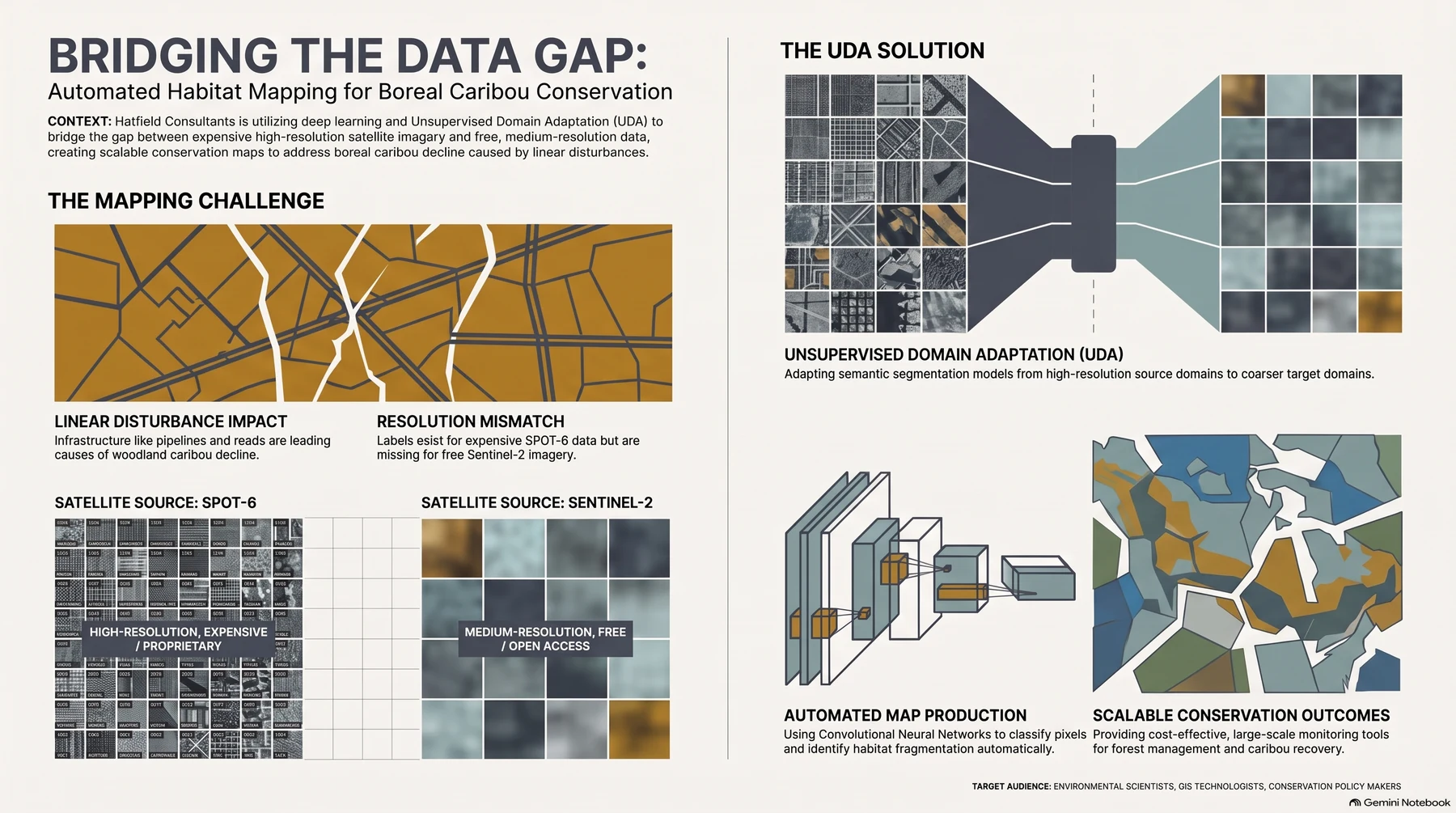
About this showcase
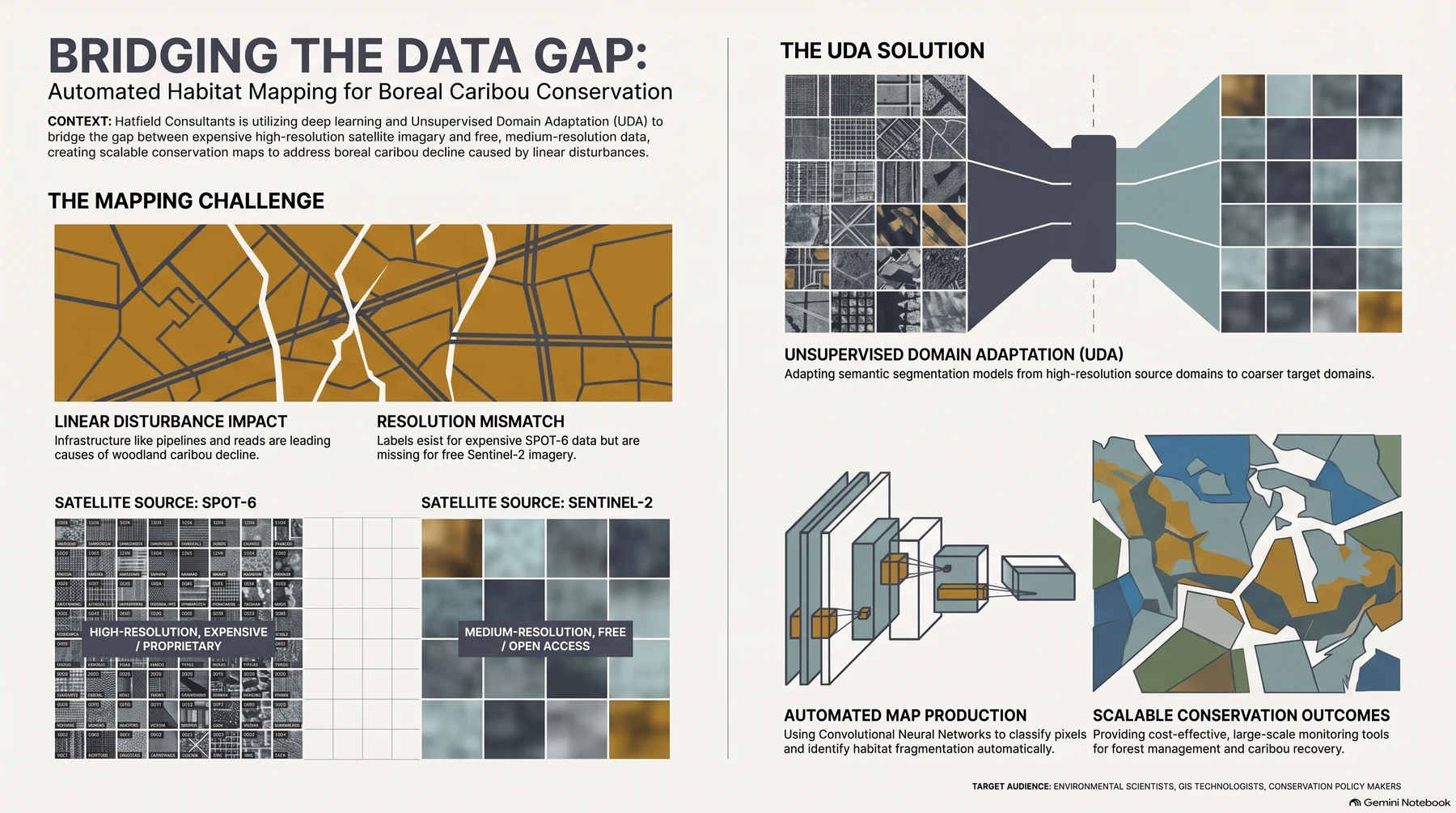
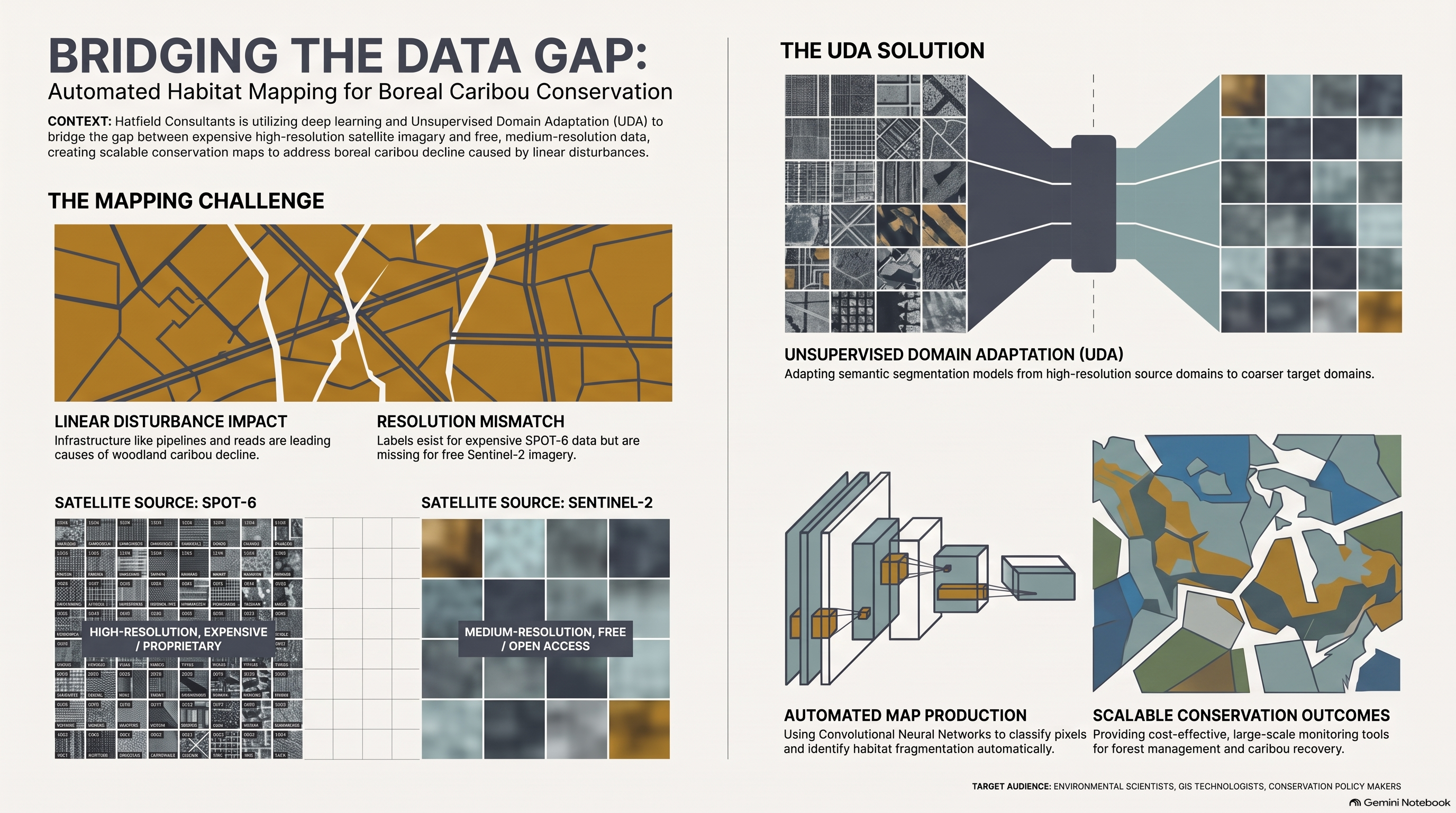
In Canada's vast northern region of boreal forest and wetlands, disturbances such as roads, seismic exploration, pipelines, and energy transmission corridors are a leading cause of the decline of woodland caribou (Rangifer tarandus) - boreal population. As a result, a deep understanding of these "linear disturbances" has become a research and forest management priority in Canada. An ideal tool to support managing linear disturbances is a way to automatically generate cost-effective maps that accurately identify this form of forest habitat fragmentation.
As a result, the focus of this project is to develop an approach for automated map production from multispectral satellite images using deep learning methods. Specifically, convolutional neural networks designed for classifying each pixel in a satellite image will be used to produce linear disturbance maps from Sentinel-2 data. The main research challenge to be addressed is that labels were developed using expensive high-resolution SPOT-6 satellite data, and there are no equivalent labels for the free and medium-resolution Sentinel-2 data. Thus, the proposed work will develop an unsupervised domain adaptation approach, which aims to take the data and corresponding labels from one domain and adapt it for training semantic segmentation models in a related, but different domain.
The main benefit of this work is advancing methods for monitoring the fragmented habitats affecting the boreal Caribou herds at scale, thereby supporting important conservation outcomes. Additional benefits include advancing general unsupervised domain adaptation from finer spatial resolution domains to coarser ones, providing improved opportunities to use freely available Sentinel-2 data for other related environmental monitoring tasks, and developing baseline methodology to build upon for spectral or time-series analysis.
Additional material
At a glance
- Company Hatfield Consultants LLP
- SectorEnvironmental Monitoring
- Presented byChristopher Henry, University of Manitoba